
Navigating at Night: Equipment and Protocols for Safe Evening Passages
At a Glance: Key Night Navigation Takeaways
Navigation Light Compliance: Ensure your port, starboard, and all-round white lights comply with UK Colregs regulations before setting off.
Preserving Night Vision: Dim console displays and switch chartplotters to night-vision palettes to maintain natural scotopic vision.
Harbour Approach Pilotage: Identify leading lights, sectored marks, and lateral buoys early against background shore lighting.
Throttle Discipline: Cruise at safe displacement speeds, maintain a dedicated lookout, and never outrun your stopping distance.
Night navigation in a powerboat is the disciplined practice of piloting a motor vessel between sunset and sunrise by relying on certified navigation lights, marine electronics, visual beacons, and reduced speeds to maintain situational awareness. Transitioning into coastal boating after dark transforms familiar coastal landmarks into unrecognisable silhouettes, making methodical preparation essential. Whether you are returning to your home mooring in an agile BRIG Navigator 20 or planning a longer coastal crossing aboard an Eagle 10, understanding night cruising protocols ensures your passage remains safe, predictable, and enjoyable.
What Are the UK Rules for Boat Navigation Lights?
Under the International Regulations for Preventing Collisions at Sea (Colregs), power-driven vessels underway are legally required to display designated navigation lights between sunset and sunrise, as well as during restricted daytime visibility. For powerboats under 12 metres—including the Falcon and Navigator ranges—this typically consists of red (port) and green (starboard) sidelights combined with an all-round white light, or separate masthead and stern lights.
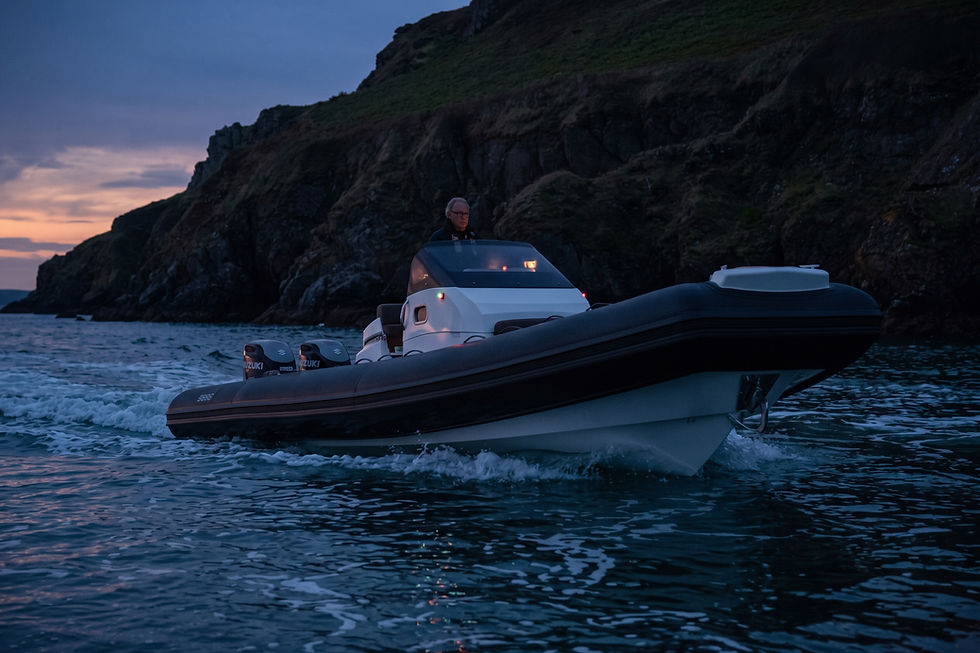
Prior to departing the pontoon, inspect all fittings for salt corrosion and test every circuit. Ensure your console and deck courtesy lights are switched off while underway; stray ambient glare on the windscreen or across the tubes destroys your natural vision and prevents you from spotting unlit objects such as floating debris, lobster pot markers, or smaller unpowered craft.
How Should You Configure Chartplotters and Electronics for Night Vision?
Human eyes take roughly 20 to 30 minutes to adapt fully to dark conditions, yet a single burst of bright white light can reset that adaptation instantly. Modern multi-function displays (MFDs) feature dedicated night-mode palettes that shift the interface into deep red, amber, or high-contrast monochrome dark backgrounds.
The ergonomic console layout on the BRIG Navigator 20 offers ample flush-mount space to position chartplotters directly within your forward line of sight. Before setting out, dim your screen backlighting to its lowest functional level and turn down engine instrument backlights. Rely on audible waypoint and shallow-water alarms so your focus stays fixed on the horizon rather than buried in the screens.
How Do You Interpret Harbour Approach Beacons?
Locating a harbour entrance after dark is often complicated by bright background light pollution from towns, marinas, and streetlamps. The key to successful pilotage is cross-referencing your nautical chart with the specific light characteristics of local navigational aids.
Note the rhythm, flash colour, and period of approach buoys well before arrival. Port (red) and starboard (green) lateral marks define the navigable channel, while cardinal marks flash white in distinct sequences (quick flashes corresponding to 3, 6, 9, or 12 on a clock face) to indicate where safe water lies. In many UK harbours, leading lights—two aligned beacons positioned at different elevations—provide an exact transit line to guide your vessel down the deepest section of the fairway.
Why is Throttle Control Vital for Coastal Boating After Dark?
Reduced visibility significantly compresses your effective reaction zone. While the reinforced deep-V hull of the BRIG Navigator 20 handles rough coastal water with ease, cruising on the plane in total darkness eliminates the margin for error required to dodge unlit obstacles.
Maintain a moderate displacement or semi-displacement speed that ensures your stopping distance is well within your line of sight. Assign an attentive crew member to serve as a dedicated forward lookout, and keep engine noise low enough to hear audio cues like navigational fog signals, breaking waves near the shoreline, or approaching traffic.
Frequently Asked Questions
Should I keep a marine searchlight switched on while driving at night?
No. Cruising with a spotlight turned on reflects light off your own bow and water spray, instantly blinding your crew and other vessels. Keep searchlights off, reserving them only for brief checks of mooring buoys or unlit harbour entrances.
Can GPS and radar replace a visual lookout after dark?
No. Rule 5 of the Colregs mandates that every vessel maintain a proper lookout by sight and hearing at all times. Small kayaks, semi-submerged wood, and paddleboarders rarely show up on marine radar or electronic charts.
What safety equipment is recommended specifically for night passages?
Equip all crew with automatic lifejackets fitted with water-activated lights and personal locator beacons. Carry red-filtered headtorches, a waterproof handheld VHF, and a ready set of coastal distress flares.
What should I do if I feel disorientated near the coast?
Throttling down to neutral or gentle idle in open, deep water gives you time to assess your surroundings. Check your depth sounder, re-orientate your heading via the compass and chartplotter, and locate known flashing beacons before moving forward.
Speak to the BRIG UK Team
Setting your RIB up with the right electronics, radar arches, and navigation lighting makes after-dark coastal exploration both safe and rewarding. If you would like expert guidance on outfitting your boat for evening passages, get in touch with our team.


